Northern Lights Shine Bright Over North Dakota
expand_more
thumb_upLike
thumb_downDislike
sendShare
library_addSave
flagReport

Live Storms Media check_circle
0 subscribers
It is one of those sights that many think is only obtainable if they travel to the northern parts of the planet. An aurora, sometimes referred to as polar lights, northern lights or southern lights, is a natural light display in the Earth's sky, predominantly seen in the high-latitude regions. But in recent years the gorgeous Aurora Borealis can also be seen in some remote parts of continental US.
Zach Hargrove, from Live Storms Media, captured absolutely stunning shots of the nothern lights over North Dakota.
Here’s a little science for you. Auroras are produced when the magnetosphere is sufficiently disturbed by the solar wind that the trajectories of charged particles in both solar wind and magnetospheric plasma, mainly in the form of electrons and protons, precipitate them into the upper atmosphere due to Earth's magnetic field, where their energy is lost. The resulting ionization and excitation of atmospheric constituents emits light of varying color and complexity.
That is why the Aurora shows different colors in different parts of the world. In the northern countries, it may show varying shades of blue, purple and green. Lower, it shows only the green spectrum.
In northern latitudes, the effect is known as the aurora borealis or the northern lights. The southern counterpart, the aurora australis or the southern lights, has features almost identical to the aurora borealis and changes simultaneously with changes in the northern auroral zone. The Aurora Australis is visible from high southern latitudes in Antarctica, Chile, Argentina, New Zealand, and Australia.
Credit: Zachary Hargrove/Live Storms Media.
1
vid:229009
Comments0
unfold_more

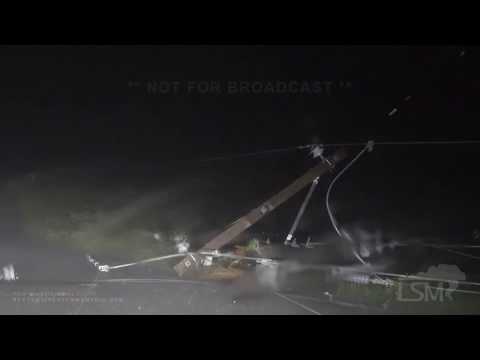
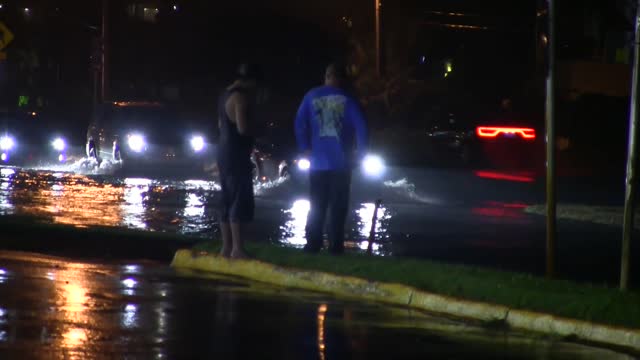
Significant flash flooding took place during the evening on September 28th across portions of Walton and Okaloosa Counties. Destin proper ended up receiving over a foot of rainfall and the drainage system could not handle it. Many roads ended up with deep water and stalled vehicles in them, including US-98 and FL-293 near the Mid-Bay Bridge. Credit: Brett Adair / Live Storms Media
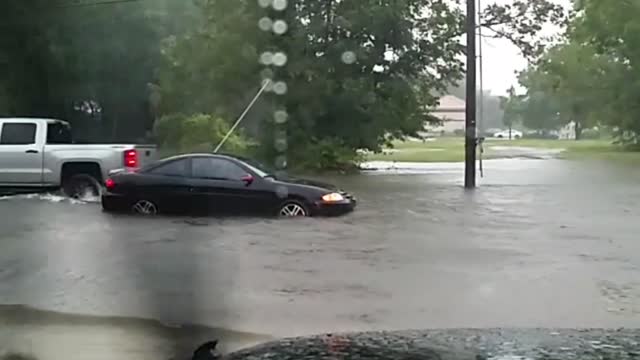
Flooding was no match for a few vehicles who decided to go through waters of 1 to 2 feet deep in parts of Pascagoula on Sunday. Even a motorcycle went through the water like it was nothing. However, you don't know if there are pockets of deeper water when you do this. Please, turn around and don't drown. Credit: Tiffany Strunk / Live Storms Media





Thinking of buying gold or switching your 401k to Gold visit www.goldbusters.co.uk/ and speak to Adam and James
Join Charlie on his Insiders Club every Wednesday & Saturday www.charlieward.com
Thinking of buying gold or switching your 401k to Gold visit www.goldbusters.co.uk/ and speak to Adam and James
Join Charlie on his Insiders Club every Wednesday & Saturday www.charlieward.com
FOLLOW CHARLIE ON TELEGRAM NEW LINK https://t.me/officialcharliewardfriends


READ: https://www.judicialwatch.org/censorship-coordination-election/
Judicial Watch received 110 pages of heavily redacted records from the U.S. Department of Homeland Security (DHS) in a Freedom of Information Act (FOIA) lawsuit that show state election officials in the days before and after the 2020 election flagging online content deemed “misinformation” and sending it to the Center for Internet Security (CIS), a DHS-funded nonprofit, the Cybersecurity and Infrastructure Security Agency (CISA), the Election Integrity Partnership (EIP), and others.


Break out of the MATRIX - https://jointherealworld.com/?a=gqqhpt7t8p
https://jointherealworld.com/a/gqqhpt7t8p
https://rumble.com/c/VVaccines
https://rumble.com/c/VCovid
https://rumble.com/c/Vcabal
https://humansbefree.com/category/5g-dangers
Cities AND entire countries have taken action to ban, delay, halt, and limit 5G installation AS WELL AS issue moratoriums due to economic, environmental, health, and public safety risks.
report 5g to increase power consumption by 61 times from 2020 to 2030
Image: Pixabay
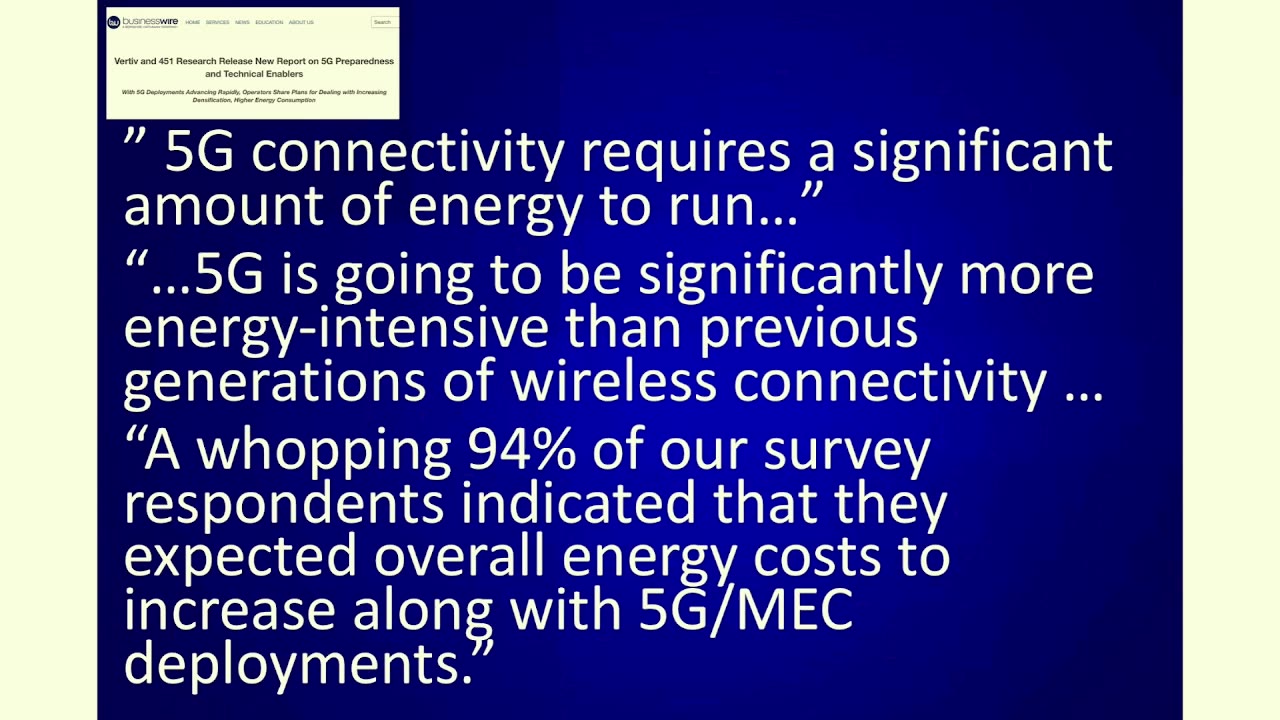
Increased energy consumption is both an economic and environmental concern. 5G requires millions of small cells and/or antennas to operate.
Recently, China announced having close to 800,000 5G towers in operation. France announced having 22,000+. 170 cities and municipalities in Germany have 5G.
Of course, those aren’t the only locations where 5G has been deployed (see 1, 2, 3, 4). The point is that experts keep pointing out that 5G needs a whole lot more energy to operate (see 1, 2, 3, 4). Some folks are very concerned about that.
From Environmental Health Trust:
ABI Research White Paper: 5G and Energy Consumption
A 2020 ABI Research DataCenter Forum white paper Environmentally Sustainable 5G Deployment reports that 5G could increase power consumption by 61 times from 2020 to 2030. This is one of numerous industry report stating that 5G and the phenomenal growth in internet traffic from the internet of things will dramatically increase energy consumption.
Environmental Health Trust has compiled a list of White papers and research report documenting the increased energy consumption from 5G and wireless networks. Please download EHT’s List of Studies on 5G and Increased Energy Use and EHT’s Factsheet on 5G and Climate Change
Excerpts from the white paper:
“As 5G usurps LTE, energy consumption is expected to increase 61x between 2020 to 2030 due to the energy demands of powerful network elements like massive MIMO and edge servers, the proliferation of 5G cell sites, and the flexibility of the 5G networks in both consumer and enterprise use cases”
“Power consumption of the 5G network is expected to soar due to active network elements like energy-hungry baseband units, remote radio heads, small cells, and core networks”
“As 5G deployment continues to gain momentum, the energy consumption of cellular network will outpace the energy consumption growth in many countries. Growing at 9% CAGR, the cellular network is expected to grow at the same rate as prominent emerging economies in the world, such as Vietnam and Bangladesh.
“By 2030, global cellular network will break into the top 20 ranking for the global household or domestic energy consumption ranking by country, consuming 51.3 Mtoe per year, or roughly the same amount of energy as all the households in Australia and the United Kingdom.”
“end devices constituting 37% of the overall energy consumption of the cellular network by 2030”
Environmental Health Trust is working to ensure that the environmental footprint of 5G and future networks be considered. Streaming with wireless results in higher greenhouse gas emissions compared to safer, faster, and more secure corded/wired fiber-optic connections. The solution is two fold.
Companies must not only actively manage and reduce their carbon emissions with more energy-efficient networks, device hardware/software changes, greener data centers and environmentally sustainable manufacturing processes.
More importantly, communities must prioritize wired connections in homes and buildings as well as design end user devices with easy to use plug and play wired capabilities.
The report documents “key steps to make 5G Greener” stating that “Telefonica claims that they have achieved a global reduction of almost 50% of their CO2 emissions since 2015.
Other major CSPs, such as BT Group, Deutsche Telecom, Orange, Verizon and Vodafone have made similar pledges to actively manage and reduce their carbon emissions.” The report states that currently steps being taken include:
championing the adoption of renewable energy
improving the energy efficiency of network elements and user devices through enhancement in data transmission, reduction of control-signaling overhead, and improvement in link adaption
greening data centers with efficient cooling involving airflow design and management
influencing stakeholders in the industry value chain to adopt similar standards and help to bring down the overall carbon footprint.
However these steps are not enough. The report states that “as more and more 5G network infrastructure are getting deployed, more aggressive energy optimization methods and technologies need to be developed to address the increase in carbon footprint.” ABI recommends the following actions:
more energy-efficient baseband units and antennas with selective switch-off of certain active RAN components. Basestations and small cells can be put dynamically into a sleep state when there is no traffic.
speeding up the integration of AI algorithms to help to reduce unnecessary energy consumption equipment that is idle during low traffic scenarios.
accelerate the use of renewable energy and passive equipment cooling.
real-time site status monitoring help reduce maintenance workload in remote rural areas.
Recommendations for device manufacturers to reduce the carbon footprint include:
Manage power utilization by various hardware and software components in a device.
Make power efficiency as key requirement in procuring displays and display processing units.
More power efficient video transmission
Better battery technology
“We must consider the environmental footprint, in addition to the technological impact, to ensure 5G and future generations of wireless technologies exist and thrive in a responsible and energy-stable world.”- Henry Tirri, Chief Technology Officer, InterDigital. (Environmentally Sustainable 5G Deployment WHITE PAPER / NOV2020 / ABI, SUSTAINABILITY).
Environmental Health Trust has compiled a list of White papers and research report documenting the increased energy consumption from 5G and wireless networks. Please download EHT’s List of Studies on 5G and Increased Energy Use and EHT’s Factsheet on 5G and Climate Change.
Since 2017, doctors and scientists have asked for 5G moratoriums on Earth and in space (see 1, 2). Since 2018 there have been reports of people and animals experiencing symptoms and illnesses after installation (see 1, 2, 3, 4). The majority of scientists worldwide oppose deployment. Doctors, scientists, and telecom whistleblowers have also endorsed a boycott on 5G phones.