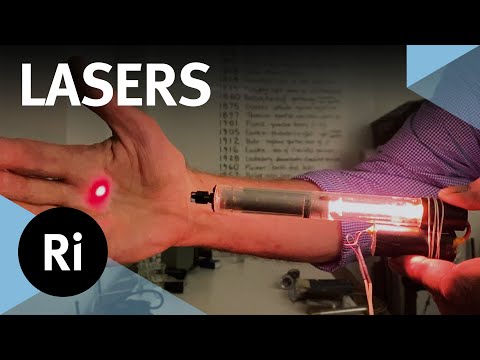
The laser is a key part of so much of our modern world, from fibre-optic cabling to eye surgery.
The origin story of lasers goes all the way back to the pioneering work of Isaac Newton. Join Andrew as he spins a tale of the the study of light and lasers, from Newton's prisms to the Nobel prize winning laser photochemistry of George Porter.
Andrew would like to thank Steve Conduit, physics technician at Highgate School, and Jonathan Ryder, precision engineer, for their considerable help in the preparation and explanation of the demonstrations on this talk.
Chapters:
00:00 - Introduction
03:50 - What is a laser?
06:28 - Newton and the prism
09:42 - The wave theory of light
10:50 - Everyday types of light
14:41 - Young and diffraction
16:24 - Dalton's atomic theory
17:50 - Lines in the solar spectrum
20:00 - Faraday and electromagnetism
22:45 - The spectroscope and spectral analysis
29:14 - Matter and light
35:20 - Crookes' radiometer
39:12 - JJ Thompson and the electron
41:29 - Planck's constant
45:08 - Albert Einstein and the photoelectric effect
47:25 - Looking inside the atom
50:54 - Exciting electrons and the laser
53:00 - Metastability
54:45 - The first lasers
56:20 - A modern gas laser
Andrew Szydlo is a chemist and secondary school teacher at Highgate School, well-loved by pupils and Ri attendees alike. He has given public lectures around the country, been featured on TV shows and has become a popular regular face on our channel.
Subscribe for regular science videos: http://bit.ly/RiSubscRibe
The Ri is on Patreon: https://www.patreon.com/TheRoyalInstitution
and Twitter: http://twitter.com/ri_science
and Facebook: http://www.facebook.com/royalinstitution
and Tumblr: http://ri-science.tumblr.com/
Our editorial policy: http://www.rigb.org/home/editorial-policy
Subscribe for the latest science videos: http://bit.ly/RiNewsletter
,Ri,Royal Institution,royal institute,WfCItXZ7dFo,UCYeF244yNGuFefuFKqxIAXw, Knowledge, channel_UCYeF244yNGuFefuFKqxIAXw, video_WfCItXZ7dFo,2025 is the International Year of Quantum Science and Technology, as marked by the UN, to celebrate 100 years since the birth of quantum mechanics. But quantum science is one of the least diverse areas of science in terms of gender and other protected characteristics.
Jess Wade, a physicist and lecturer in functional materials at Imperial College London, has been fighting the inequality in quantum physics and beyond by creating thousands of Wikipedia pages for women scientists. Jess joins us this month to discuss the past, present, and future of quantum science along with what can be done to increase diversity within the field.
Ri Science Podcast episodes are released on the last Wednesday of every month. Subscribe wherever you get your podcasts to be notified as soon as episodes are released!
---
Jess Wade is a British physicist in the Blackett Laboratory at Imperial College London, specialising in Raman spectroscopy. Her research investigates polymer-based organic light emitting diodes (OLEDs). Her public engagement work in science, technology, engineering, and mathematics (STEM) advocates for women in physics as well as tackling systemic biases such as gender and racial bias on Wikipedia. Read more about here here: https://en.wikipedia.org/wiki/Jess_Wade
---
Producer: Lia Hale
Assistant producers: Katie Mortimer, Isla Nakano
Interviewer: Lia Hale
Music: Joseph Sandy
--
Join this channel to get access to perks:
https://www.youtube.com/channel/UCYeF244yNGuFefuFKqxIAXw/join
Subscribe for regular science videos: http://bit.ly/RiSubscRibe
The Ri is on Twitter: http://twitter.com/ri_science
and Facebook: http://www.facebook.com/royalinstitution
and TikTok: https://www.tiktok.com/@ri_science
Listen to the Ri podcast: https://podcasters.spotify.com/pod/show/ri-science-podcast
Donate to the RI and help us bring you more lectures: https://www.rigb.org/support-us/donate-ri
Our editorial policy: https://www.rigb.org/editing-ri-talks-and-moderating-comments
Subscribe for the latest science videos: http://bit.ly/RiNewsletter
Product links on this page may be affiliate links which means it won't cost you any extra but we may earn a small commission if you decide to purchase through the link.
,Ri,Royal Institution,royal institute,MdOCu2Gr-0g,UCYeF244yNGuFefuFKqxIAXw, Knowledge, channel_UCYeF244yNGuFefuFKqxIAXw, video_MdOCu2Gr-0g,Join this channel to get access to perks:
https://www.youtube.com/channel/UCYeF244yNGuFefuFKqxIAXw/join
Subscribe for regular science videos: http://bit.ly/RiSubscRibe
The Ri is on Twitter: http://twitter.com/ri_science
and Facebook: http://www.facebook.com/royalinstitution
and TikTok: https://www.tiktok.com/@ri_science
Listen to the Ri podcast: https://podcasters.spotify.com/pod/show/ri-science-podcast
Donate to the RI and help us bring you more lectures: https://www.rigb.org/support-us/donate-ri
Our editorial policy: https://www.rigb.org/editing-ri-talks-and-moderating-comments
Subscribe for the latest science videos: http://bit.ly/RiNewsletter
Product links on this page may be affiliate links which means it won't cost you any extra but we may earn a small commission if you decide to purchase through the link.
,Ri,Royal Institution,royal institute,PLc0BCjbFcg,UCYeF244yNGuFefuFKqxIAXw, Knowledge,Religion, channel_UCYeF244yNGuFefuFKqxIAXw, video_PLc0BCjbFcg,In the first of his CHRISTMAS LECTURES, Richard Dawkins explores the origins of life. Beginning with a look at our ancestry, he shows how the probability of our existence is very small.
Watch all the lectures in this series here: https://www.youtube.com/playlist?list=PLbnrZHfNEDZwJw3_jDeusmHuVYDdKRpo9
Watch our newest Christmas lectures here: https://www.youtube.com/playlist?list=PLbnrZHfNEDZyQJZLPMjwEoOLdkFBLU2m1
This lecture was filmed at the Ri on 1 December 1991.
These lectures were originally a YouTube member exclusive for our Science Supporters, and now we’re putting them out for everyone to watch. If you can’t wait for them all to be published, get access now by signing up as a YouTube channel member, and help us bring science to more people: https://www.youtube.com/channel/UCYeF244yNGuFefuFKqxIAXw/join
---
Life grows up in the universe by gradual degrees of evolution. Billions of years ago, there existed a vast population of bacteria. But it was only an elite group of these bacteria that evolved to become humans. In truth, we are lucky to be alive.
In the first of his CHRISTMAS LECTURES, Richard Dawkins explores the origins of life. Beginning with a look at our ancestry, he shows how the probability of our existence is very small. Becoming an ancestor is much more difficult than simple reproduction, and Richard reveals how our ancestors did what it took to survive and pass on their genes.
But although some of our life must be devoted to perpetuating it, surely there must be more to it? Richard explores the role of art and culture in society, and examines how the capabilities of the human body have enabled us to accomplish complex tasks.
When it comes to our understanding of the meaning of life, science is important. As Richard explains, science can help us uncover both when we arrived on this planet, and why we are here. Some people turn to the supernatural for the answer to such questions. Richard looks at the limitations of beliefs in the supernatural and uses a cannonball to prove why instead we should have faith in science and its predictions.
--
About the 1991 CHRISTMAS LECTURES
The world-famous evolutionary biologist Richard Dawkins presents the CHRISTMAS LECTURES on "our own growing knowledge of how life grows up in the universe."
Just as children grow up to be adults, so too does life gradually evolve on a planet over thousands of generations, to move from “nonliving simplicity” to become “living complexity”.
Combining beautiful writing with a range of illuminating demonstrations, the series featured a variety of wildlife, a virtual reality Lecture Theatre, and special guests – including the late Douglas Adams reading an excerpt from The Hitchhiker's Guide to the Galaxy.
Find out more about the Ri CHRISTMAS LECTURES here: https://www.rigb.org/christmas-lectures
---
Join this channel to get access to perks:
https://www.youtube.com/channel/UCYeF244yNGuFefuFKqxIAXw/join
Subscribe for regular science videos: http://bit.ly/RiSubscRibe
The Ri is on Twitter: http://twitter.com/ri_science
and Facebook: http://www.facebook.com/royalinstitution
and TikTok: https://www.tiktok.com/@ri_science
Listen to the Ri podcast: https://podcasters.spotify.com/pod/show/ri-science-podcast
Donate to the RI and help us bring you more lectures: https://www.rigb.org/support-us/donate-ri
Our editorial policy: https://www.rigb.org/editing-ri-talks-and-moderating-comments
Subscribe for the latest science videos: http://bit.ly/RiNewsletter
Product links on this page may be affiliate links which means it won't cost you any extra but we may earn a small commission if you decide to purchase through the link.
,Ri,Royal Institution,royal institute,sO5adbV_mu8,UCYeF244yNGuFefuFKqxIAXw, Knowledge, channel_UCYeF244yNGuFefuFKqxIAXw, video_sO5adbV_mu8,Watch the Q&A for Sean Carroll's lecture on Einstein's equation explaining spacetime. You can watch the original lecture here: https://youtu.be/BRudidBcfXk
The original lecture and this Q&A were recorded at the Ri on Monday 14 August 2023.
Our lecture Q&As are usually a perk for our YouTube Science Supporters, as a thank you for helping us bring science to more people, but we're publishing this one for everyone as Sean's talk has been so popular.
A huge thank you to our YouTube members for helping us to bring you more science. You can join them here: https://www.youtube.com/channel/UCYeF244yNGuFefuFKqxIAXw/join
Subscribe for regular science videos: http://bit.ly/RiSubscRibe
The Ri is on Twitter: http://twitter.com/ri_science
and Facebook: http://www.facebook.com/royalinstitution
and TikTok: https://www.tiktok.com/@ri_science
Listen to the Ri podcast: https://podcasters.spotify.com/pod/show/ri-science-podcast
Our editorial policy: https://www.rigb.org/editing-ri-talks-and-moderating-comments
Subscribe for the latest science videos: http://bit.ly/RiNewsletter
Product links on this page may be affiliate links which means it won't cost you any extra but we may earn a small commission if you decide to purchase through the link.
,1,Join this channel to get access to perks:
https://www.youtube.com/channel/UCYeF244yNGuFefuFKqxIAXw/join
Subscribe for regular science videos: http://bit.ly/RiSubscRibe
The Ri is on Twitter: http://twitter.com/ri_science
and Facebook: http://www.facebook.com/royalinstitution
and TikTok: https://www.tiktok.com/@ri_science
Listen to the Ri podcast: https://podcasters.spotify.com/pod/show/ri-science-podcast
Donate to the RI and help us bring you more lectures: https://www.rigb.org/support-us/donate-ri
Our editorial policy: https://www.rigb.org/editing-ri-talks-and-moderating-comments
Subscribe for the latest science videos: http://bit.ly/RiNewsletter
Product links on this page may be affiliate links which means it won't cost you any extra but we may earn a small commission if you decide to purchase through the link.
,1,🔦Protect yourself from violent crime with this life-saving gadget: 🔦
http://www.fighterflare.com
Get 15% OFF Using Promo Code 15OFF
👕Merch: https://gforemanbcp.com/
🤙🏾 Patreon: https://www.patreon.com/blackconservativeperspective
👊Paypal: paypal.me/gforemanbcp
💸Cash App: $gforemanbcp
🏃♂️Follow me on Twitter: https://twitter.com/gforemanBCP @gforemanBCP
📷 Follow me on Instagram: https://www.instagram.com/gforemanbcp/
⭐ Wooden American Star:
https://bridgethegapshop.com/discount/GFOREMANBCP
Nikki Haley it was hard growing up as a brown girl.
Legal Disclosure: I’m not a financial advisor. The information contained in this video is for entertainment purposes only. Before investing, please consult a licensed professional. Any stock purchases I show on video should not be considered “investment recommendations”. I shall not be held liable for any losses you may incur for investing and trading in the stock market in an attempt to mirror what I do. Investments may decline in value and/or disappear entirely. Please be careful!
,1,The laser is a key part of so much of our modern world, from fibre-optic cabling to eye surgery.
The origin story of lasers goes all the way back to the pioneering work of Isaac Newton. Join Andrew as he spins a tale of the the study of light and lasers, from Newton's prisms to the Nobel prize winning laser photochemistry of George Porter.
Andrew would like to thank Steve Conduit, physics technician at Highgate School, and Jonathan Ryder, precision engineer, for their considerable help in the preparation and explanation of the demonstrations on this talk.
Chapters:
00:00 - Introduction
03:50 - What is a laser?
06:28 - Newton and the prism
09:42 - The wave theory of light
10:50 - Everyday types of light
14:41 - Young and diffraction
16:24 - Dalton's atomic theory
17:50 - Lines in the solar spectrum
20:00 - Faraday and electromagnetism
22:45 - The spectroscope and spectral analysis
29:14 - Matter and light
35:20 - Crookes' radiometer
39:12 - JJ Thompson and the electron
41:29 - Planck's constant
45:08 - Albert Einstein and the photoelectric effect
47:25 - Looking inside the atom
50:54 - Exciting electrons and the laser
53:00 - Metastability
54:45 - The first lasers
56:20 - A modern gas laser
Andrew Szydlo is a chemist and secondary school teacher at Highgate School, well-loved by pupils and Ri attendees alike. He has given public lectures around the country, been featured on TV shows and has become a popular regular face on our channel.
Subscribe for regular science videos: http://bit.ly/RiSubscRibe
The Ri is on Patreon: https://www.patreon.com/TheRoyalInstitution
and Twitter: http://twitter.com/ri_science
and Facebook: http://www.facebook.com/royalinstitution
and Tumblr: http://ri-science.tumblr.com/
Our editorial policy: http://www.rigb.org/home/editorial-policy
Subscribe for the latest science videos: http://bit.ly/RiNewsletter
,1,Where Does Genius Come From?
New videos DAILY: https://bigth.ink/youtube
Join Big Think Edge for exclusive videos: https://bigth.ink/Edge
----------------------------------------------------------------------------------
Genes and environment don’t determine different quantities of our success (or failure). Instead, they operate together in surprising and complex ways.
----------------------------------------------------------------------------------
David Shenk:
David Shenk is the national bestselling author of five previous books, including "The Forgetting," "Data Smog," and "The Immortal Game." He is a correspondent for TheAtlantic.com, and has contributed to National Geographic, Slate, The New York Times, Gourmet, Harper's, The New Yorker, NPR, and PBS. His new book, "The Genius in All of Us," will be published by Doubleday in March 2010.
----------------------------------------------------------------------------------
TRANSCRIPT:
Question: What is genius, and what does it mean to say we all have it?
David Shenk: Well genius is an amorphous term to be sure and I actually try to stay away from it in the book. What I talk about in the book mostly is this idea of high achievement, so people becoming great at stuff, becoming really, really good at stuff. I don’t think it’s really important to make a dividing line to try to figure out you know when you’ve crossed over into genius. The point is gathering your resources, doing the best you can, pursuing whatever it is you love to do with an intensity and a resilience and a passion and just going as far as you can possibly go.
Question: Why do you believe the “nature-nurture” distinction to be a false one?
David Shenk: Sure, so this is a big part of my book and it has a long history. We’ve been living with this myth for about a hundred, hundred and fifty years, going back to the time of Darwin, although I’m not blaming Darwin for this. If the blame resides anywhere it’s really with Darwin’s cousin Francis Galton. We can get into that if you’d like, but so the idea is that we think that it’s nature versus nurture, that there is genes that have all this information that kind of want to push us in a certain direction and then there is the environment, which is nurture, which is obviously different and kind of an opposing force and it’s kind of either or and there are all these studies that are constantly trying to figure out well how much is nature and then add onto the nurture. You know is it 60% nature, 40% nurture depending on what trait you’re talking about? Well it turns out that genes don’t work that way. Genes don’t get you part of the way there you know to the point you’re born or the point shortly after that or before that. Genes are always interacting with the environment, so the new way to think about this is that it’s not nature plus nurture on nature versus nurture. If anything it’s nature interacting with nurture if you have to use those words, so one of the phrases that scientists are using now is G Times E, that is genetics times environment as opposed to G plus E. They call it an additive model. The additive model is well, you have so much inborn intelligence and then plus what you get in the environment. That would be the you know nature plus nurture. The new model is you can’t separate them. You just absolutely cannot separate the effects of genes from the effects of the environment, so all we can do of course is to identify the resources that we have in our environments and maximize them as best we can.
Question: How does research with lab mice demonstrate the fallacy of the nature-nurture distinction?
David Shenk: Right, so there have been some… The science that I’m describing in the book is really lots and lots of different pieces of science from different realms of science and if there is any contribution in this book it’s really putting them together. It’s bringing all these different disparate pieces together and it’s giving a voice and some phrasing and some metaphors to what scientists have been really trying to say for a long time and just haven’t quite… They know what they’re trying to say, of course. They understand the stuff, but they haven’t quite been able to interpret it well for the public. So one of the studies is… goes back to 1957 or ’58, where these two guys were looking at rats that had been genetically designed, genetically bred that is, to be intelligent, and in generation after generation they were incredibly intelligent in you know as seen in mazes and things like that. So then they wanted to see, well, what if you subject them to different environments, extreme environments like sensory deprivation kind of thing or extra treats and you know so called intellectual stimulation for rats if you can imagine what that is.
Read the full transcript at https://bigthink.com/videos/where-does-genius-come-from/
,1,Video originally uploaded by: End Times Productions
Channel URL: https://www.youtube.com/channel/UCBlXSyoT2PCHp-oMvPIEN6w/featured
All the videos that I upload on my YT channel is simply just a mirror of the original content creators, hand picked.
Some of these videos were taken down by YT. I capture these videos as soon as they are downloaded before YT takes them down and blocks them.
I have made all the videos available to watch and download from my shared drive, to get access send me an email at [email protected]
My channel is NOT monetized!
I'm not doing this for subscribers or to promote my channel, I'm simply doing this to get the truth out and to provide an alternative way to watch, download and share these videos via my shared drive.
ALL CREDIT GOES TO THE ORIGINAL CONTENT CREATORS, THANK YOU FOR YOUR HARD WORK AND GETTING THE TRUTH OUT IN THE WORLD WE LOVE YOU AND APPRECIATE YOU.